
The decision between Low-Code vs Pro-Code Software Development shapes how teams move fast while maintaining control. As organizations weigh speed, cost, scalability, and risk, the choice often hinges on empowering citizen developers with low-code platforms or relying on traditional pro-code engineering. This article unpacks the differences, advantages, and trade-offs of each path, offering a practical framework to decide which approach to use in different situations, including when to use low-code. You’ll discover how low-code advantages and limitations shape project timelines, governance, and long-term maintainability, while pro-code development benefits deepen when performance, security, and complex integrations are required. We also compare no-code vs low-code vs pro-code and tie the discussion back to enterprise application development guidelines to help teams choose the right mix for scalable, governed delivery.
Viewed through the lens of rapid application development, organizations weigh platform-assisted builders against traditional software engineering. Citizen developers, visual design tools, and reusable components enable quick experiments, while seasoned engineers focus on performance, data integrity, and complex integrations. Understanding when to lean on low-code platforms versus handcrafted code involves enterprise application guidelines, risk management, and long-term maintainability. For teams exploring all three paths—no-code, low-code, and pro-code—an informed pivot through governance, tool selection, and migration planning helps balance speed with control. The goal is a pragmatic blueprint: start rapid with accessible builders, then elevate critical components to professional software development as requirements mature.
Low-Code vs Pro-Code Software Development: Balancing Speed, Control, and Governance
In the modern development landscape, teams constantly weigh the speed of delivery against the need for control. This tension sits at the heart of Low-Code vs Pro-Code Software Development, where low-code approaches offer rapid prototyping and closer business collaboration, while pro-code emphasizes performance, security, and long-term maintainability. When evaluating options, organizations should consider the nuanced trade-offs captured by the concept of low-code advantages and limitations, recognizing how these platforms accelerate work for many use cases yet may require careful governance for complex requirements. The goal is to align speed-to-value with risk management, so teams can move fast without compromising core quality expectations.
A practical path often emerges through a hybrid model: start with low-code to accelerate delivery, then progressively migrate mission-critical components to pro-code as governance, scalability, and data stewardship demands grow. This approach aligns with enterprise application development guidelines that emphasize clear ownership, repeatable patterns, and auditable pipelines. By combining the strengths of both worlds, organizations can maintain velocity in front-end tooling and prototypes while preserving the reliability and extensibility expected of core systems.
Low-Code vs Pro-Code Software Development: Balancing Speed, Control, and Governance (Extended Insights)
With governance and risk in mind, the decision framework becomes more nuanced. Pro-code development benefits include full control, robust security, and the ability to optimize complex integrations and data processing, which are essential for mission-critical environments. Meanwhile, low-code platforms shine in rapid iteration, stakeholder alignment, and the ability to surface insights from business users who are closest to the processes being digitized. Understanding where each approach excels—and where pressures for customization or governance considerations arise—helps teams design scalable architectures that remain adaptable as needs evolve.
For organizations aiming to sustain momentum, documenting a clear hybrid blueprint is crucial. The blueprint should specify which components live in low-code and which in pro-code, along with governance checkpoints, data lineage, testing strategies, and migration plans. By treating governance as a standard practice rather than a gate, teams can preserve agility while ensuring traceability, reproducibility, and long-term maintainability across the software lifecycle.
No-Code, Low-Code, and Pro-Code: A Practical Perspective for Enterprises
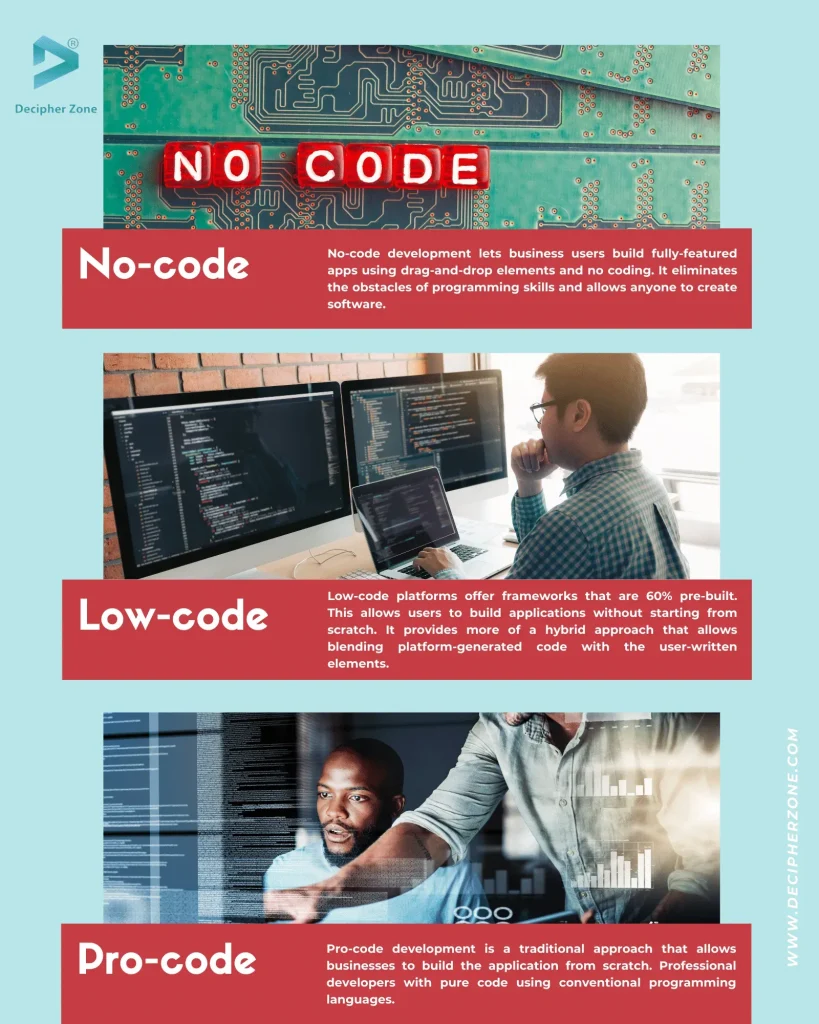
This perspective highlights how no-code vs low-code vs pro-code concepts intersect with real-world needs. While no-code targets highly automated, low-complexity workflows, low-code extends the reach to more complex scenarios with visual modeling and reusable components. The discussion of this balance echoes the broader theme of no-code vs low-code vs pro-code, where the aim is to empower citizen developers without relinquishing governance and security controls. Organizations should assess where non-developers can add value and where specialized engineering is required to meet performance and regulatory requirements.
From an architectural standpoint, enterprises benefit from establishing light governance guardrails and templates to standardize data models, security rules, and integration patterns across both low-code and pro-code environments. This alignment supports faster onboarding, consistent quality, and smoother migration paths as projects scale, ensuring that the benefits of rapid tooling do not outpace the organization’s ability to manage risk and maintain accountability.
Pro-Code Development Benefits: Robustness, Security, and Long-Term Maintainability
Pro-code development benefits center on flexibility, performance, and robust governance. By leveraging traditional programming languages, mature architectures, and rigorous testing practices, teams can design systems that handle complex business logic, high throughput, and stringent security requirements. The emphasis on structured code, automated testing, and traceability reinforces how pro-code supports enterprise-grade resilience and compliance, which are often non-negotiable for mission-critical applications.
While pro-code delivers enduring value, it also comes with trade-offs in delivery speed and resource intensity. Teams should weigh the need for long-term maintainability against the speed advantages of low-code, and plan for phased implementations that protect governance, data integrity, and scalability. Emphasizing a well-defined migration strategy and alignment with enterprise application development guidelines helps ensure pro-code investments pay off through durable architecture and adaptability to evolving business needs.
Frequently Asked Questions
Low-Code vs Pro-Code Software Development: What are the main low-code advantages and limitations, and when to use low-code in an enterprise context?
In Low-Code vs Pro-Code Software Development, low-code advantages include rapid prototyping, faster time-to-value, and enabling citizen developers, while its limitations involve customization ceilings, vendor lock-in, and potential performance constraints. Use low-code for simple to moderately complex apps, internal tools, dashboards, and prototyping, but plan for pro-code for mission-critical systems requiring security, advanced integrations, or long-term governance. Enterprises often adopt a hybrid approach: start with low-code to accelerate delivery and migrate core components to pro-code as requirements mature.
How does no-code vs low-code vs pro-code fit into Low-Code vs Pro-Code Software Development, and what enterprise application development guidelines help decide which path to take?
The ‘no-code vs low-code vs pro-code’ spectrum helps decide based on risk, complexity, and governance. No-code suits narrow, non-technical workflows; low-code supports more complex apps with visual models; pro-code delivers full customization, performance, and strict governance. Following enterprise application development guidelines, map requirements to capabilities, ensure data governance and security, plan migration paths, and apply a hybrid strategy when appropriate. For larger, mission-critical projects, leverage pro-code development benefits for control, scalability, and robust governance; otherwise, start with no-code/low-code and scale to pro-code as needs evolve.
| Topic | Key Points |
|---|---|
| What are Low-Code and Pro-Code? | Low-Code uses visual interfaces, prebuilt components, and declarative logic; Pro-Code relies on traditional programming languages with full control over code. |
| Core Distinction | Control vs speed: Low-Code shortens time-to-value; Pro-Code enables advanced performance, bespoke logic, and rigorous governance. |
| Practical Framework Dimensions | Requirements complexity, speed to value, customization and control, governance and risk, and skills/collaboration. |
| Low-Code Benefits | Speed and agility; lower entry barrier; potential cost efficiency for non-critical workloads; reuse and consistency. |
| Low-Code Limitations | Customization limits; vendor lock-in; performance constraints; security and governance complexity. |
| When to Use Low-Code | Rapid internal tools and dashboards; prototyping; enabling citizen developers; front-end workflows and lightweight integrations. |
| No-Code vs Low-Code vs Pro-Code | No-code targets non-technical users with limited customization; low-code handles more complex scenarios; balance, extendability, and governance are central. |
| Pro-Code Benefits | Full control and flexibility; capable of complex integrations and enterprise-grade backends; strong governance and traceability. |
| Pro-Code Limitations | Longer delivery timelines; higher resource needs; ongoing maintenance overhead. |
| When to Use Pro-Code | Mission-critical systems with strict security/compliance needs; highly customized logic; large-scale, robust architecture. |
| Hybrid Approach & Decision Framework | Adopt hybrid patterns: start with low-code for speed, migrate core components to pro-code as requirements mature; emphasize governance and risk management. |
| Governance, Security & Compliance | Low-Code: clear ownership, guardrails, access controls, data portability. Pro-Code: version control, automated tests, CI/CD, security-by-design, and regulatory documentation. |